

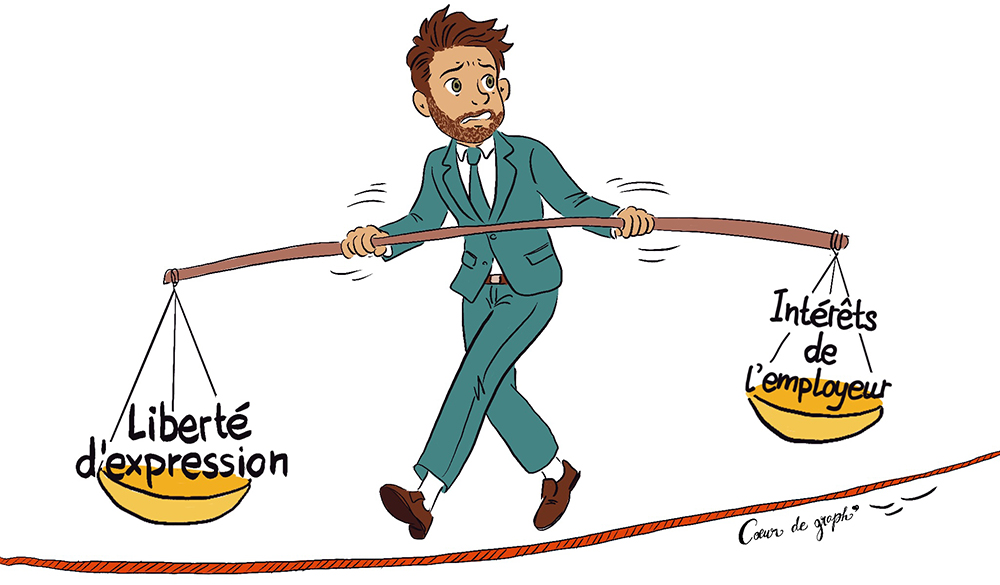
 A dismissal that infringes on freedom of expression would not necessarily be ruled as unfair, because being entitled to express yourself doesn’t mean there aren’t any limits, and the courts acknowledge an employer’s right to set boundaries.
So what tips the balance?
What will the courts take into consideration when deciding whether an employee has gone too far?
Will the courts look at whether the statements made by the employee were offensive or untrue? Yes they will, but that’s only part of the picture, as shown in the most recent decisions handed down by the French Court of Cassation (Cour de cassation).
What they’ll do is go back in time, exploring the whole contractual relationship, looking in particular at:
• the exact nature of the statements concerned; but more than anything:
• the context in which the words were delivered;
• their reach and impact within the company;
• their adverse effects on the employer.
Examples of where the balance will tip in favour of the employer include if the employee’s behaviour or words are shown to have been aggressive or in bad faith, if they cannot be explained by particular circumstances that would mitigate their impact (such as the employer’s own failings), if the employee widely publicised them, or if they jeopardised the company’s business, the running of a team, or the health and safety of employees or others.
So, deciding what course to take depends on the context of the events.
Case studies
1. Imagine you’re visiting your great aunt who’s in a nursing home because she’s suffering from Alzheimer’s. In the lift you come across a care worker who’s yelling at a colleague that she’s going to knock the living daylights out of them as soon as she gets the chance. You’re horrified to think that your great aunt is in the care of such an aggressive person, so you speak about it to the director of the home.
The home’s main doctor happens to come out of the director’s office and he also has been appalled by some of the things the same care worker has said. Apparently, she’d been telling everyone that she won’t look after your great aunt because of her type of illness, and that people like her shouldn’t be in the nursing home.
The director thinks about what she should do. The nursing home is meant for people suffering from Alzheimer’s, whatever the care worker thinks. And what’s more, the care worker has been given special training on looking after residents with Alzheimer’s. In view of the worker’s aggressive behaviour, the director is worried that she could mistreat the home’s residents, who are vulnerable. As this is a risk she cannot take, she sees no other solution than to dismiss the care worker for serious misconduct.
At the end of the legal proceedings related to the case, the court ruled in favour of the director’s decision, stating that by dismissing the employee for disciplinary reasons, the employer had taken “a measure that was necessary, appropriate and proportionate to the objective of providing a caring and supportive environment for vulnerable elderly people” (Cass. soc., 14 Jan. 2026, n° 24-13.778, Sté Les Sinoplies).
2. Now we’re in a small company that advises clients on tax optimisation schemes in real estate. One morning, the Chair of the company receives a letter from the accounting assistant accusing him of conducting a “fraudulent business” and threatening to report him to the authorities.
Looking at it like this, you might say that the employee has gone too far and that she should be sacked on the spot before she can do any irreparable damage.
But if we contextualise and look at the overall contractual relationship, we can see that:
• the Chair sent several insulting e-mails to the employee who always remained polite;
• the employee was on sick leave for depression;
• she had not received any income for three months due to her employer not doing what they were supposed to do, even though she had sent several requests to sort the situation out, which had remained unanswered;
• she ended up by suggesting that they sign a severance agreement, which the employer seemed to be interested in but then didn’t respond to the employee;
• she had several discussions with the company’s clients which, in her position as an accounting assistant – with limited knowledge on tax issues – led her to believe that the tax optimisation schemes the company was proposing were illegal, thereby making her complicit in fraud.
So given what we know now, that changes things doesn’t it? In view of this context, the court held that her dismissal for serious misconduct based on the accusations she made against her employer was invalid, because although she may have been outspoken, she only addressed the Chair, she was not insulting (unlike him), and she only wanted to ensure that she was not complicit in tax fraud (Cass. soc., 28 Jan. 2026, n° 24-21.881, Sté Industrial Invest).