

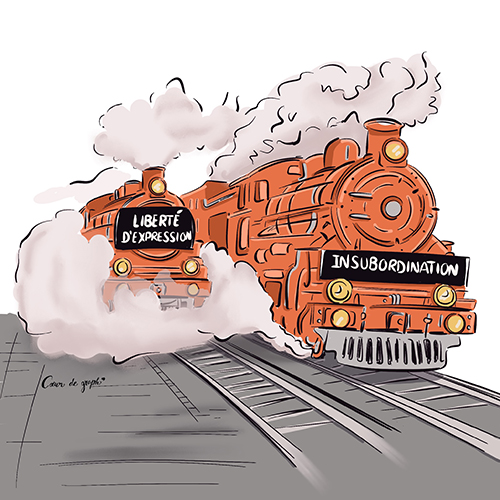
 Companies aren’t supposed to be dictatorships, and every employee has the right to express themselves freely, without offending others. Dismissing an employee just because their views are unpopular obviously infringes on their freedom of expression and is therefore unlawful.
But it’s not always easy to identify an infringement on freedom of expression
French case law has held that refusing to carry out certain tasks can constitute the expression of disagreement with Management decisions (Cass. soc., 14 Jan. 2026, n° 24-13.778, sté Les Sinoplies).
It has also held that giving an HR manager a caricature of themselves putting employees in the dustbin is a form of freedom of expression (Cass. soc., 14 Jan. 2026, 23-19.947, Airbus).
And an employee asking for the company Chair to be present in a meeting scheduled with the CEO, due to concerns that the CEO might misrepresent what they said during the meeting, has been held to be an expression of distrust towards the CEO, and therefore an expression of opinion (Cass. soc., 14 Jan. 2026, n° 24-19.583, Association des pupilles de l’enseignement public de Saône-et-Loire).
Even refusing to express an opinion has been considered freedom of expression in a case where an employee refused to prepare a press release in support of their employer! (Cass. soc., 26 Oct. 2005, n° 03-41.796, Stade Malherbe de Caen)
So why is this dangerous?
Like the submerged part of the iceberg, the hidden side of dismissals – i.e., reasons that infringe on freedom of expression – make these cases much more difficult to navigate. An employer not only has to prove the significant and serious nature of the facts, as in any litigation, but also has to convince the judge of the legitimate grounds for restricting the employee’s right to free speech.
If an employer cannot demonstrate these legitimate grounds, the dismissal will be deemed null and void. This means that it will be retroactively overturned and the employee will be able to rejoin the company (even if the case went on for several years), and the employer will have to pay the entire amount of salary that the employee would have received since the date of dismissal. If the employee decides not to go back to the company, they can be awarded at least six months’ salary in compensation, irrespective of how long they actually worked for the company.
In addition, infringement on freedom of expression is “radioactive”. In other words, even if just one of the reasons for a dismissal is considered as an infringement on freedom of expression, then all of the other reasons set out in the dismissal letter can be deemed invalid.
So what do employers need to be careful of?
Most importantly, they need to check whether any of the reasons for dismissing an employee is based on the employee having expressed an opinion, within the extremely broad meaning of the term. If there are several reasons for the dismissal, it may be more prudent to remove any motive that could be considered in any shape or form as an infringement on freedom of expression.
For example, is it really necessary to say that an employee vehemently objected to Management’s decision not to give them a promotion, if the reason for the dismissal was that they were incapable of doing their job? This purely contextual information could muddy the waters more than anything else.
And if one of the reasons for an employee’s dismissal can be considered as related to freedom of expression, then get ready to go to court, as a dispute is almost inevitable given that the “Macron” scale of compensation sets the minimum amount of compensation for cases of unfair dismissal for other reasons at less than six months’ worth of salary!